Save big on peptide bundles!

Peptides 101: The Cell’s “Text Messages” and the Science Behind Them
Michael Cole
1/17/20265 min read


"Peptides" went from an obscure biochemistry term to a mainstream buzzword very quickly—often attached to oversized promises. We are not doing that here.
In a research context, peptides are best understood as messengers: short chains of amino acids that bind to specific targets (usually receptors) to trigger cellular signaling. That signaling—what gets turned on, turned off, or modulated within a cell—is why researchers continue paying close attention to these molecules.
This post is your foundation for understanding what peptides physically are, how they signal, what broad research categories exist, and what "research-grade" actually means in a laboratory setting.
Peptides are short amino acid chains linked by peptide bonds. They are smaller than full proteins and are often used by biological systems as signaling molecules.
Many peptides act by binding to specific cell receptors, initiating signal cascades inside the cell.
Popular areas of laboratory research include tissue signaling, growth hormone pathway signaling, and metabolic signaling—but the strength of evidence varies significantly by specific peptide and claim.
In research, quality control is paramount: purity testing combined with identity verification is necessary to protect data reproducibility.
The Research Objective: Understanding Cellular Signaling
To navigate the complex world of peptide research without falling for marketing hype, you need a clear objective.
The goal is to understand peptides at a chemistry level, understand their "mechanism of action" at a signaling level, and know exactly what to look for on a Certificate of Analysis (COA) so you aren't fooled by a simple "purity" number alone.
What Is a Peptide? The "Short Protein" Concept
Peptides and proteins live on the same biochemical spectrum: both are made of amino acids linked together by peptide bonds.
Peptides are generally defined as short amino acid chains (typically fewer than 50 amino acids).
Proteins are typically longer chains that fold into complex, stable 3D structures to carry out broader structural or enzymatic functions.
If proteins are the complex machines of biology, peptides act as the precise messages that help coordinate what those machines do.
Mechanism of Action: Receptors, Binding, and Signaling Cascades
When researchers discuss a compound's "mechanism of action," they are asking three fundamental questions:
What does it bind to? (The target receptor)
What happens next? (The signal transduction or cascade)
What measurable changes occur afterward? (Cell outputs like gene expression shifts,
secretions, or changes in cellular behavior)
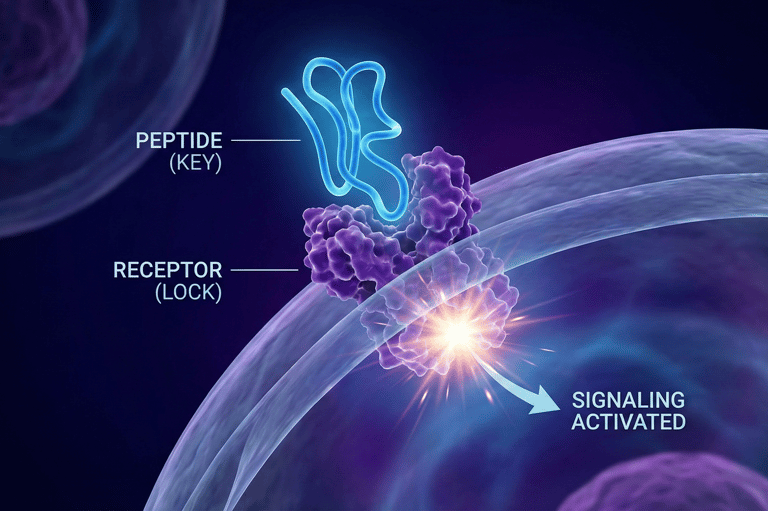
The "Lock and Key" Model
While real biology is nuanced, the "lock and key" teaching model remains useful for
visualizing why sequence and shape matter so much.
The Lock: A receptor (often located on the cell surface membrane).
The Key: A specific peptide sequence with the exact shape designed to fit that receptor.
Binding acts like flipping a switch, initiating a cascade of downstream signals inside the cell.
Key Areas of Laboratory Study
1. Tissue Signaling and Angiogenesis (Blood Vessel Formation)
Angiogenesis is the process of new capillaries forming from existing blood vessels—a normal biological process supporting tissue remodeling and growth.
In research settings, certain peptides are investigated for how they may influence signaling environments related to cell migration, matrix signaling, and vascular signaling.
It is vital to note that research interest is not the same as established proof. The strength of evidence depends heavily on the specific peptide and the specific claim being investigated.
Example: BPC-157. There is robust preclinical interest in this compound, and recent scientific reviews emphasize the need for well-designed human trials to clarify its safety and efficacy profile.
2. Growth Hormone Pathway Signaling (Secretagogues)
Some peptides are studied for how they interact with pathways related to natural growth hormone regulation—either by mimicking upstream signals or interacting with receptors involved in GH physiology.
Example: CJC-1295. A published clinical study in healthy adults reported sustained increases in GH and IGF-1 biomarkers following administration in a controlled setting. It is crucial to understand that a biomarker finding in a controlled study is not the same as a verified long-term health outcome.
3. Metabolic Signaling (Incretins)
GLP-1 is a gut-derived peptide hormone secreted after meals. It has been studied extensively for years regarding its role in glucose-dependent insulin secretion and related physiology.
This category is a clear example of the bigger point: peptides are not "new magic." They are part of the body’s normal signaling toolkit, and researchers learn a great deal by studying how these signals are sent, received, and translated into cellular action.
Why Purity and Identity Matter for Reproducibility
In real laboratory research, reproducibility is paramount. If an experiment cannot be repeated with the same results, the data is useless.
A standard claim of "98–99% purity" is helpful, but purity alone does not answer the most critical questions:
Is the main peak on the chromatogram actually the correct molecule?
Are the remaining percentage points made of truncations, synthesis byproducts, or degradation products that could skew results?
Does the chemical identity actually match the label?
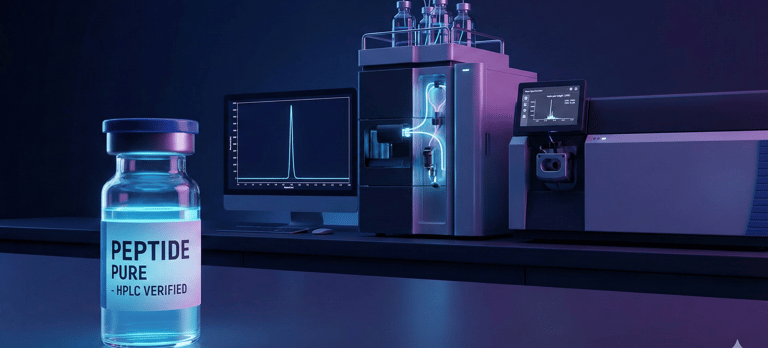
This is why serious research workflows pair High-Performance Liquid Chromatography (HPLC) with Mass Spectrometry (MS).
HPLC (Purity) asks: "How much is the dominant component compared to everything else?"
MS (Identity) asks: "Is the dominant component actually what you think it is based on its molecular weight?"
Myths vs. Facts in Peptide Research
Myth: "Peptides are magic." Fact: Peptides are messaging molecules. Their mechanisms are real, but outcomes depend entirely on the strength of evidence for a specific context.
Myth: "A plausible mechanism guarantees results." Fact: Mechanisms are merely hypotheses until they are supported by strong data for a specific claim.
Myth: "High purity is all that matters." Fact: Purity without identity confirmation is a major reproducibility risk in the lab.
Myth: "All peptides are basically the same." Fact: Sequence, shape, and receptor interactions vary massively. Even small changes to an amino acid sequence can radically alter a peptide's function.
Key Takeaways for Researchers
Peptides are short amino acid chains that often function as highly specific biological signals.
Many act by binding receptors and triggering complex intracellular signaling cascades.
"Peptides" as a broad category is not a single evidence bucket; the strength of science varies radically by molecule.
For research integrity, look beyond simple purity claims. Identity confirmation and impurity profiling matter.
Disclaimer: This article is for educational purposes only and discusses basic biochemistry and research concepts. It does not constitute medical advice and is not intended to diagnose, treat, cure, or prevent any disease. All products offered by 4Balance Peptides are strictly intended for in vitro and laboratory research use only and are not intended for human consumption.
References
NHGRI Genetics Glossary. "Peptide" (definition and context). Available at genome.gov.
Nature Scitable. "Peptide" (foundational definition; peptide vs protein distinction). Available at nature.com/scitable.
FDA Guidance. Distribution of In Vitro Diagnostic Products Labeled for Research Use Only or Investigational Use Only. Available at fda.gov.
Teichman et al. (JCEM). Prolonged Stimulation of Growth Hormone (GH) and Insulin-Like Growth Factor I Secretion by CJC-1295, a Long-Acting Analog of GH-Releasing Hormone, in Healthy Adults.
Diabetes (ADA Journal). Glucagon-Like Peptide-1 Secretion by the L-Cell.
Cleveland Clinic. Angiogenesis definition (high-level overview).
Sikiric et al. (Springer). Stable Gastric Pentadecapeptide BPC 157 and Wound Healing.
We pride ourselves on providing high quality products that are safe and effective. All of our research products are made with the highest quality ingredients, and undergo rigorous testing to ensure purity and potency.
CONTACT INFO
(864) 387-5929
© 2025. All rights reserved.








807 Holland Rd
Simpsonville, SC 29681