Save big on peptide bundles!

The GLOW Peptide Protocol: A Complete Guide to Regenerative Recovery
What it is, who it's for, what the research shows, and how to use it responsibly.
Michael Cole
3/3/20269 min read
If you've spent any time in the fitness or recovery world recently, you've probably heard the word "peptides" more than a few times. And if you've dug a little deeper, you've likely come across GLOW. It's one of the most talked-about peptide protocols in regenerative wellness right now, and for good reason: it combines three complementary peptides that address different bottlenecks in the healing process, working together in ways that exceed what any single compound achieves alone.
But there's a lot of noise around peptides in general, and we think you deserve a clear, honest, evidence-based walkthrough of what GLOW actually is, what it does, who it's designed for, and just as importantly, who it isn't for. We've used it ourselves. We've seen what it can do for clients. And we've also seen what happens when people approach it without the right understanding or guidance. This post is our attempt to lay out everything we know so you can make an informed decision.
What Is GLOW? The Three-Peptide Protocol
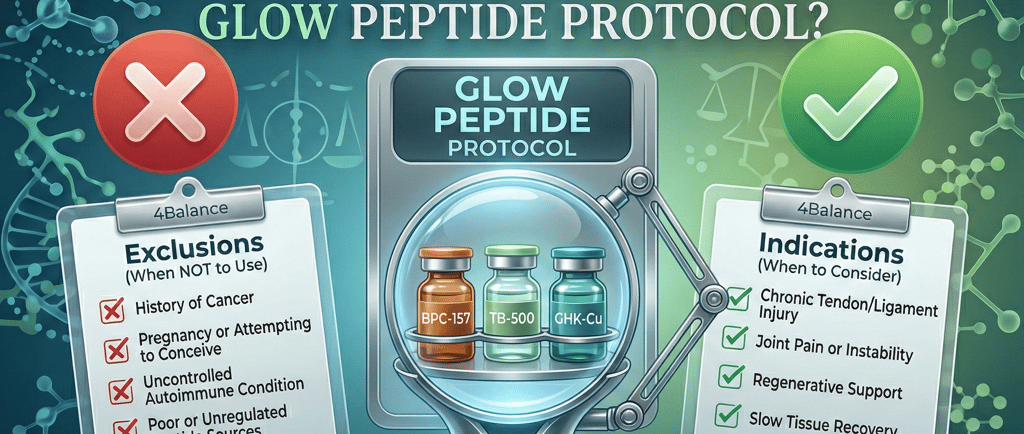
GLOW is a structured regenerative protocol combining three peptides: BPC-157, TB-500, and GHK-Cu. Each one addresses a different aspect of tissue repair, and their complementary roles are what make the protocol more than the sum of its parts. Think of it this way: healing isn't one process. It's a sequence of overlapping biological events, including circulation, cellular migration, inflammation regulation, collagen synthesis, and structural remodeling. GLOW provides support at multiple points along that sequence.
The fundamental distinction with peptides is that they represent restoration of natural biological function, not chemical interference with broken biology. Your body already produces these compounds. What declines with age, injury, and chronic inflammation is the signaling capacity. GLOW is designed to restore that signaling.
BPC-157 (Body Protection Compound) is naturally occurring in human gastric juices and plays a role in tissue protection and repair. Its primary mechanism is angiogenesis, the formation of new blood vessels. BPC-157 builds new roads so that healing supplies can reach damaged tissues. When a tendon or ligament is injured, one of the biggest obstacles to recovery is limited blood flow to the area. BPC-157 addresses that bottleneck directly by promoting new vasculature, along with fibroblast activity and nitric oxide signaling. A 2018 study published in Pharmacology demonstrated accelerated gastric ulcer healing with zero adverse effects. It's also been used in Phase II ulcerative colitis trials without adverse events. The preclinical literature on tissue repair, collagen synthesis, and cytoprotection is extensive, though it's worth noting that large-scale human trials remain limited. BPC-157 production naturally decreases with age and chronic inflammation, which is part of why supplementation can make a measurable difference.
TB-500 (Thymosin Beta-4) is a naturally occurring 43-amino acid peptide. The synthetic form used in protocols like GLOW mimics the active fragment (amino acids 17 through 23) responsible for its regenerative properties. Where BPC-157 builds the infrastructure, TB-500 coordinates the repair work itself. Its primary mechanisms involve cellular migration (getting repair cells to the injury site), angiogenesis, and inflammation regulation. If BPC-157 builds the highway, TB-500 puts the ambulance on it. A 2008 study published in the American Journal of Pathology showed that TB-500 improved post-infarct cardiac function by promoting angiogenesis and reducing cell death. It's the only peptide shown to reverse fibrosis in the myocardium in preclinical models. It also supports soft tissue repair and neurogenesis, upregulates IL-10 (an anti-inflammatory cytokine), and prevents cardiomyocyte apoptosis.
GHK-Cu (Copper Tripeptide-1) is a naturally occurring copper-binding peptide that declines significantly with age. Its role in GLOW is structural: it supports collagen synthesis, tissue integrity, and long-term remodeling quality. Research shows that GHK-Cu stimulates fibroblast proliferation and migration, regulates matrix metalloproteinases (the enzymes that break down and rebuild extracellular matrix), and modulates inflammatory gene expression. Gene microarray studies have found that GHK-Cu upregulates over 4,000 genes involved in tissue repair, antioxidant defense, and stem cell recruitment. Clinical research includes a 2019 study showing a 15% increase in skin elasticity (measured clinically), a 2023 study demonstrating significant hair regrowth via VEGF pathways, and a 2020 comparison where a copper peptide formulation outperformed 3% Minoxidil in density metrics. GHK-Cu also functions as an antioxidant cofactor for superoxide dismutase, adding another layer of tissue protection.
Why they work together: The logic behind combining all three is that healing involves multiple overlapping processes, and addressing just one leaves gaps. BPC-157 builds the vascular infrastructure. TB-500 coordinates the cellular repair response. GHK-Cu ensures the structural quality of what gets rebuilt. Results from combining BPC-157 and TB-500 tend to exceed what either achieves alone. Adding GHK-Cu extends that synergy into the collagen remodeling phase, which is where long-term tissue resilience is determined.
What GLOW Is Not
This is worth saying clearly. GLOW is a regenerative support protocol. It is not a painkiller. It is not a performance drug. And it does not replace proper diagnosis, correct biomechanics, progressive loading, adequate nutrition, quality sleep, or any other foundational health practice. It supports biology. It does not replace fundamentals.
If someone is looking for a shortcut that lets them skip physical therapy or ignore the root cause of their pain, GLOW is not the answer. If someone has a structural problem that requires surgical intervention, GLOW won't fix it. The protocol works best when it's layered on top of a foundation that's already in place, not as a substitute for one that doesn't exist. Peptides support biology. They do not replace fundamentals.
Who Is a Good Candidate for GLOW?
The most important factor here isn't age, fitness level, or athletic background. The most important factor is whether the problem you're trying to solve actually aligns with what GLOW does. Not every injury or recovery challenge is a tissue repair problem. And not every tissue repair problem will respond to peptide support. The fit has to be there.
That said, there are five groups that consistently benefit the most.
People with chronic tendon or ligament injuries. Tendons and ligaments heal slowly by design. They have limited blood supply and complex remodeling requirements. When tendinopathy persists despite physical therapy, when pain improves but strength doesn't return, when flare-ups happen with loads that should be manageable, or when imaging shows degeneration, GLOW may be appropriate. It supports the repair environment, organizes remodeling, and helps rebuild collagen quality over time. Think Achilles tendinopathy, rotator cuff tendinosis, patellar tendinopathy, tennis elbow, or chronic wrist ligament sprains.
People with recurrent joint pain or instability. Joint pain is rarely just a cartilage problem. The capsule, ligaments, tendons, and surrounding connective tissue all determine how force is distributed. When these structures are compromised, pain tends to return no matter how many times it's treated symptomatically. GLOW is a fit when sprains or strains keep recurring in the same joint, when joints feel unstable or unreliable under load, when pain persists despite normal imaging, or when capsular or ligamentous laxity is suspected.
Athletes and active adults with slow recovery. High training volume exposes connective tissue to repetitive micro-stress. When recovery capacity falls behind load, injuries accumulate. If your recovery time between sessions has increased, if minor injuries never fully resolve, if training is limited by connective tissue pain rather than muscular fatigue, or if age-related recovery decline is noticeable, GLOW supports the biological side of the equation while training adjustments handle the mechanical side. One without the other rarely works.
People undergoing regenerative procedures. If you're doing prolotherapy or PRP, those procedures stimulate a healing response, but the quality of the outcome depends on what happens during tissue remodeling afterward. GLOW supports post-procedure collagen remodeling, controls inflammation without blunting the repair signal, and promotes organized tissue rebuilding rather than fibrosis. It enhances the biological response without replacing the procedure itself.
People experiencing age-related decline in tissue resilience. Aging involves declining angiogenesis, declining collagen quality, and declining recovery signaling. GLOW directly addresses all three of those mechanisms. For active older adults who want to maintain their physical capacity and connective tissue resilience, the protocol targets exactly the biological processes that slow down with time.
Who Should Not Use GLOW
This is just as important as knowing who benefits. There are clear contraindications that should not be glossed over.
Active cancer or recent cancer without oncology clearance. While GLOW is not a growth hormone protocol, any therapy that influences tissue repair and remodeling should be approached with extreme caution in the context of active or recent cancer. Oncology clearance and individualized risk assessment are essential. This is non-negotiable.
Pregnancy or attempting conception. Peptide safety data during pregnancy is limited. Even if individual peptides appear low-risk in isolation, stacking them adds uncertainty. GLOW is not appropriate during pregnancy or while actively trying to conceive.
There are also gray areas that don't rule GLOW out entirely but require modification and careful medical oversight. Autoimmune conditions may require lower starting doses and immune-first strategies. Multiple simultaneous injuries may benefit from sequenced treatment rather than stacking everything at once. Complex medication regimens require interaction review. And severe deconditioning may mean foundational rehab needs to come before peptides enter the picture. These nuances are exactly why clinician guidance matters. Protocols should be adapted to the individual, not copied from the internet.
The Research Landscape
We want to be transparent about where the evidence stands for each component, because understanding the quality of the data is part of making an informed decision.
BPC-157 has decades of preclinical data showing angiogenesis, collagen synthesis, and cytoprotection across multiple biological systems. The 2018 Pharmacology study on gastric ulcer healing showed accelerated recovery with zero adverse effects. It's been used in Phase II ulcerative colitis trials. A retrospective analysis of 12 patients showed 7 experiencing meaningful knee pain relief. The mechanisms are well-characterized and genuinely promising. The limitation: large randomized controlled human trials specifically for musculoskeletal applications are still developing. The biological plausibility is strong, and the clinical experience is growing, but we're still waiting for the kind of large-scale human data that would make this ironclad.
TB-500 has strong preclinical support for cell migration, angiogenesis, and inflammation regulation. The 2008 American Journal of Pathology cardiac study is significant because it demonstrated actual tissue regeneration, not just symptom management, in a damaged heart model. The peptide has shown the ability to reduce apoptosis, upregulate anti-inflammatory cytokines, and promote soft tissue repair and neurogenesis. Most of this data comes from animal models. Human clinical guidelines are still being established, and large human trials are limited. But the biological mechanisms are well-understood, and clinical practitioners report consistent outcomes when sourcing and dosing are controlled.
GHK-Cu has some of the most interesting data of the three, partly because it's been studied for longer in dermatological and wound-healing contexts. The 2019 clinical study showing a 15% increase in skin elasticity was measured rather than self-reported. The 2023 hair regrowth study demonstrated significant results via VEGF pathways. The 2020 comparison outperforming 3% Minoxidil in density metrics adds further weight. And the gene microarray data showing upregulation of 4,000+ genes involved in tissue repair, antioxidant defense, and stem cell recruitment suggests a much broader biological role than skin alone. The mechanism data are extensive. The clinical data for topical and injectable applications are growing.
What Matters Most for Safety and Success
Here's what we've learned from our own experience and from watching the peptide space closely: the biggest risks with GLOW aren't about the peptides themselves. They're about execution. Poor sourcing. Dosing errors. Skipping medical screening. Using peptides as a substitute for sleep, protein, and progressive loading. Those are the variables that determine outcomes far more than the protocol itself.
The sourcing problem deserves special attention. Recent testing by BTLabs found that at least 20% of unapproved peptides tested since October 2025 were mislabeled. Vials labeled as one compound contained a different one entirely. Peptide concentrations didn't match labels. Contamination was documented. This is the reality of the gray market, and it's why sourcing from regulated, clinician-supervised sources isn't optional. It's the difference between a protocol that works and one that's a gamble.
The peptide isn't the variable. The variable is sourcing, dosing, and monitoring. When those are handled correctly, the safety profile is strong. When they're not, outcomes are unpredictable regardless of how good the science behind the peptides might be.
GLOW as a Regenerative Strategy, Not a Shortcut
Connective tissue heals slowly by design. Muscle repairs in weeks. Tendons take months. Ligaments can take months to years to fully remodel. And the quality of that remodeling matters more than the speed. Scar tissue that forms quickly but disorganized is weaker than tissue that remodels slowly but with proper collagen alignment. GLOW supports the remodeling process. It doesn't bypass it.
What GLOW actually does is support circulation to injured tissues (BPC-157), coordinate cellular migration and repair (TB-500), and rebuild structural collagen quality (GHK-Cu), while regulating inflammation without blunting the repair signal. The result is an environment that favors organized remodeling rather than fibrosis or incomplete healing.
What GLOW doesn't do is make injuries heal instantly, replace physical therapy and progressive loading, compensate for poor sleep or inadequate protein or a high-inflammation diet, or work as a standalone tool without a lifestyle foundation underneath it. Outcomes depend roughly 70% on execution (loading, nutrition, sleep, stress management) and 30% on the peptide itself. We think that's about right. The best candidates for GLOW understand that healing is a process, value structure and supervision over quick fixes, and are willing to commit to the fundamentals alongside the protocol.
Is GLOW Right for You?
GLOW is not for everyone, and that's actually a strength. It's most appropriate for people with connective tissue problems that align with its mechanisms and who are willing to approach recovery systematically. Here's a quick self-assessment (not a diagnosis, but a starting point for conversation):
Do you have a tissue healing problem that aligns with what GLOW targets (tendons, ligaments, joints, connective tissue)? Have conventional approaches like physical therapy, rest, and conservative care been partially effective but incomplete? Are you willing to commit to progressive loading, adequate protein (1.6g per kg bodyweight), consistent sleep, and stress management alongside the protocol? Do you understand this is a months-long process, not a quick fix? Are you free from contraindications (active cancer, pregnancy, severe unmanaged autoimmune disease)? And are you willing to work with a clinician for screening, sourcing, and monitoring?
If you answered yes to all of those, GLOW may be worth exploring.
Ready to Explore GLOW?
If you're curious whether GLOW aligns with your recovery goals, we're here to walk through it with you. No pressure, no sales pitch. Just an honest conversation about what the research supports, what questions to ask, and whether it makes sense for your situation.
Everything we carry is sourced from regulated compounding pharmacies with verifiable testing. Browse the full lineup at 4balancepeptides.com or grab it in the gym to save on shipping.
We pride ourselves on providing high quality products that are safe and effective. All of our research products are made with the highest quality ingredients, and undergo rigorous testing to ensure purity and potency.
CONTACT INFO
(864) 387-5929
© 2025. All rights reserved.







807 Holland Rd
Simpsonville, SC 29681